
All About the Microtonal Guitar
A microtonal guitar is built or modified to play pitches that a standard 12-tone equal-tempered guitar cannot produce with its regular frets. Microtonal does not mean one specific tuning. It can refer to intervals smaller than a semitone, unequal divisions of the octave, just intonation, historical temperaments, or pitch systems used in maqam-based music.
There are several approaches. A guitar may use a fixed nonstandard fret layout, added partial frets, a fretless fingerboard, or a system of movable frets. Each solution has different advantages. Fixed layouts are quick to play once learned but tied to one system; fretless guitars allow continuous pitch control but demand precise intonation; adjustable frets combine tactile reference points with the ability to change the tuning layout.
What is an adjustable microtonal guitar?
An adjustable microtonal guitar has individual fret pieces that can be inserted, removed, or moved along channels under each string. Unlike a fretless guitar, the player still feels a fret beneath the string. Unlike a standard guitar, the player is not limited to the twelve equal semitone positions of conventional fretting.
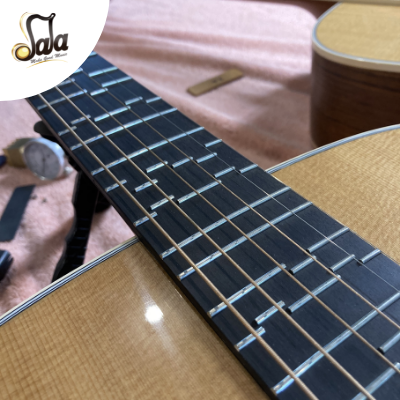
Prof. Dr. Tolgahan Çoğulu designed the Adjustable Microtonal Guitar in 2008. The project was accepted and funded at Istanbul Technical University Dr. Erol Üçer Center for Advanced Studies in Music under the supervision of Prof. Şehvar Beşiroğlu, and luthier Ekrem Özkarpat completed the first instrument in 2009. Çoğulu's design drew inspiration from earlier adjustable-fret concepts by René Lacote and Walter Vogt.
Because each string has its own channel, a fret can be positioned for one string without necessarily crossing the entire fingerboard. Players can add or remove as many fretlets as a composition requires. The system is intended for three broad uses:
- Playing maqam-based and other regional traditions on guitar.
- Performing contemporary classical works that use microtones.
- Exploring tuning systems other than 12-tone equal temperament.
Fretless classical guitars: view the collection
How does it differ from a standard guitar?

A standard guitar normally places full-width frets according to 12-tone equal temperament. Twelve equal semitone steps complete the octave. An adjustable microtonal fingerboard can retain those familiar fret positions while adding pitches between them, or it can be rearranged for a different temperament altogether.
The strings themselves are tuned in the usual way at the tuning machines. Moving a fret changes the pitch produced when a particular string is stopped at that location; it does not "tune the string to a microtone." Before playing, the musician plans the required pitch layout, positions the fretlets, and checks intonation with a tuner or reference pitch.
What music can it play?

Microtonal guitars are used for Turkish and Arabic maqam music, contemporary composition, experimental music, just intonation, historical temperaments, and many other pitch systems. The instrument does not make every tradition automatically authentic. The player must still learn the relevant intonation, melodic grammar, ornamentation, rhythm, and phrasing.
Historical European music also used temperaments other than today's standard 12-tone equal temperament. Adjustable frets can support research and performance in those systems, but the required positions depend on the chosen temperament rather than on a generic set of "extra frets."
Microtones, commas, and maqam intonation
Microtones are often described as intervals smaller than a Western semitone, but the term also covers tuning systems that divide the octave differently or use unequal intervals. Calling every microtone a quarter-tone is misleading. A quarter-tone is one possible interval; maqam traditions use pitches whose placement depends on theory, regional style, melodic direction, and performance practice.
Turkish music theory includes several systems for describing these intervals. The Arel-Ezgi-Uzdilek approach divides the whole tone into nine comma units and represents the octave with 24 named pitch positions, but this should not be confused with 24 equal divisions of the octave. Folk musicians may use other fret placements and intonation practices, especially on bağlama, and regional performance does not always follow one theoretical grid.
Advantages and practical limits
- Movable fretlets provide a physical stopping point and make repeated pitches more consistent than on a fully fretless fingerboard.
- The layout can be adapted to a composition, maqam, temperament, or experimental scale.
- Only the strings that need an altered pitch require an added or moved fret.
- Reconfiguring and checking many fretlets takes time, so changing systems between pieces requires preparation.
- Players must learn new visual and tactile positions and cannot rely entirely on standard guitar fingering.
Can a standard guitar be converted?
A conventional instrument can be converted by replacing its fingerboard with an adjustable microtonal system, but this is luthier work. Scale length, neck relief, fret height, action, and final intonation must be measured together. Poor installation can cause buzzing, uneven notes, or structural damage.
Microtonal fret option: view the product
Conclusion
The adjustable microtonal guitar expands the pitch vocabulary of a familiar instrument without removing the tactile guidance of frets. Its main value is flexibility: the same fingerboard can be prepared for maqam-based repertoire, alternative temperaments, or a composer's custom scale. That flexibility also requires careful setup and a clear understanding of the tuning system being used.


Yes, you can buy a microtonal fretboard from us. Please send an email to our team; they will help you.
email address: sales@salamuzik.com
Can you buy the fretboard separately ? With the adjustable frets it would fit on any standard guitar and the tuning would make compensation obsolete . One Kirnberger recording on youtube had a massive positive reaction .
Leave a comment